Custom Development vs. Readymade Solution: Which is Better for Building a Food Delivery App?


Published date 08th Oct, 2026
- The two most popular approaches for building a food delivery app are custom development and readymade solutions.
- Custom development offers greater control over features, workflows, integrations, UI/UX, and the long-term product roadmap.
- Readymade solutions can reduce initial development effort and help entrepreneurs launch a food delivery marketplace faster.
- The right approach depends on budget, launch timeline, customization needs, scalability, integrations, and long-term business goals.
- Before finalizing an approach, evaluate essential capabilities across restaurant, delivery partner, and admin applications, along with security and integrations.
- A phased approach using a readymade solution can help validate demand before moving toward deeper customization. Solutions such as Yo!Yumm can be considered as part of this launch strategy.
The food delivery industry is evolving day by day, creating opportunities for restaurants, foodpreneurs, and businesses to connect customers with meals through convenient digital platforms. Whether you want to build a local food delivery marketplace or launch a multi-city platform, choosing the right food delivery app development approach is one of the most important decisions you need to make.
Usually, businesses have two options: custom food delivery app development or a readymade food delivery solution. Custom development gives you the flexibility to build the platform around your exact requirements, while a ready-made solution provides pre-built functionality that can help you launch faster.
Both approaches have their own advantages and limitations. However, the right choice depends on factors such as your budget, business model, required features, customization needs, launch timeline, scalability requirements, and long-term growth strategy.
This blog compares custom development vs. readymade solutions for building a food delivery app and explains their differences in terms of features, cost, customization, development time, scalability, and business requirements.
Table of Contents
- What is Custom App Development?
- Key Benefits of a Custom Food Delivery App
- Limitations of Custom Food Delivery App Development
- What is a Readymade Food Delivery Solution?
- Key Benefits of a Readymade Food Delivery Solution
- Limitations of a Readymade Food Delivery Solution
- Custom Development vs. Readymade Solution: Key Differences
- Food Delivery App Development Cost
- Custom Development vs. Readymade Solution: Which Is Faster to Launch?
- Customization and Scalability: Custom vs. Readymade Solutions
- Features to Consider Before Choosing a Food Delivery Solution
- Which is Better for Your Food Delivery Business?
- Can You Start With a Readymade Solution and Move to Custom Development?
- How to Choose the Right Food Delivery App Development Approach
- Conclusion
- FAQs
What is Custom App Development?
Custom development involves creating a food delivery app from the ground up specifically according to your business requirements. Rather than using an existing solution with predefined functionality, the application is designed and developed from scratch.
For example, if your business follows a unique commission model, offers subscription-based deliveries, supports multiple restaurant categories, or uses a specialized delivery process, these requirements can be incorporated into the platform during development.
Custom development provides greater control over the product, including its design, features, integrations, workflows, and future development roadmap.
How Custom Food Delivery App Development Works
Custom development generally follows a structured process. It includes:
- Business and market research
- Requirement analysis
- Feature planning
- UI/UX design
- Customer app development
- Restaurant dashboard development
- Delivery partner app development
- Admin panel development
- Backend development
- Third-party integrations
- Testing
- Deployment and maintenance
A custom development process can take longer than using a readymade solution because every major component is created and configured according to the business requirements.
Key Benefits of a Custom Food Delivery App
Custom food delivery app development gives businesses greater flexibility to shape the platform around their business model, operational processes, and customer expectations. From defining unique workflows to planning for future expansion, a custom approach provides more control over how the marketplace looks, works, and evolves.
1. Complete Customization
One of the biggest advantages of custom development is the ability to create features and workflows according to your specific business model. This allows you to create a marketplace that supports your processes instead of adapting your business to a predefined platform.
You can customize:
- User journeys
- Restaurant workflows
- Delivery processes
- Commission structures
- Subscription plans
- Loyalty programs
- Promotions
- Payment processes
- Reporting and analytics
This level of customization can be particularly valuable when your business requires functionality that isn’t available in standard food delivery software.
2. Flexible UI/UX Design
Custom development also gives you greater freedom over the platform’s user experience. You can design the interface around your brand identity, target audience, and ordering journey rather than relying on a predefined template.
You can define the navigation, layouts, ordering process, restaurant discovery experience, checkout flow, and other interface elements to create a more consistent and relevant experience for your users.
3. Greater Control
With custom development, businesses have greater control over the product roadmap. You can decide which features to introduce, which integrations to implement, and how the platform should evolve as your business grows.
This level of control can be particularly useful when you plan to develop the food delivery marketplace as a long-term technology product and want the platform to adapt to changing business requirements.
4. Scalability
A custom food delivery app can be designed with future growth in mind. As your marketplace expands, you can add new features, support more users and restaurants, enter new locations, and modify workflows based on evolving operational needs.
This makes custom development a suitable option for businesses that expect their marketplace requirements to become more complex over time.
Limitations of Custom Food Delivery App Development
Custom development also comes with some considerations. While it offers greater flexibility and control, businesses should carefully evaluate the additional investment, development time, technical expertise, and ongoing maintenance required to manage a custom food delivery platform successfully.
1. Higher Initial Investment
Building a platform from scratch generally requires more development resources and a larger upfront budget compared with using a readymade food delivery solution.
2. Longer Development Time
The platform needs to go through planning, design, development, testing, and deployment, which can extend the overall time required to launch the food delivery app.
3. Technical Requirements
Businesses may need an internal technical team or a reliable development partner for ongoing development, troubleshooting, integrations, performance optimization, and maintenance.
4. Ongoing maintenance
Custom software requires regular updates, security improvements, bug fixes, performance monitoring, and feature enhancements to keep the food delivery marketplace secure, reliable, and competitive.
What is a Readymade Food Delivery Solution?
A readymade food delivery solution is a pre-built software platform that includes the core functionality required to operate a food delivery marketplace.
Instead of developing the complete platform/app from scratch, businesses can configure an existing solution, apply their branding, customize available features, integrate required services, and launch the marketplace.
A typical readymade food delivery solution may include:
- Customer app
- Restaurant dashboard
- Delivery partner app
- Admin panel
- Order management
- Payment integration
- Restaurant management
- Delivery management
- Reporting and analytics
The exact features and customization options depend on the solution and provider.
Turn Your Unique Food Delivery Idea Into A Marketplace
How a Readymade Food Delivery Solution Works
The process is generally faster than custom development. Key steps include:
- Select a suitable food delivery solution.
- Define your business requirements.
- Configure the platform.
- Apply branding and design changes.
- Customize available features.
- Integrate payment and location services.
- Test the platform.
- Add restaurants and delivery partners.
- Launch the marketplace.
Because the core functionality is already available, businesses can avoid building every component from scratch.
Key Benefits of a Readymade Food Delivery Solution
A readymade food delivery solution can help businesses avoid the time and effort involved in developing a marketplace from the ground up. With core functionality already available, entrepreneurs can focus on configuring the platform, applying their branding, making necessary customizations, and preparing for launch.
1. Faster Time to Market
A major advantage of a readymade solution is faster deployment. Since core features are already developed, businesses can focus on configuration, customization, testing, and launch. This can be particularly useful when you want to validate a business idea, respond quickly to enter a competitive market, or establish your food delivery marketplace in a competitive market.
2. Lower Initial Development Effort
A readymade solution can reduce the amount of development required at the beginning. Businesses don’t need to build every standard marketplace feature from scratch, allowing them to focus their resources on business operations, branding, customer acquisition, and market validation.
3. Pre-Built Features
Many readymade food delivery platforms come with essential functionality for managing day-to-day marketplace operations. Depending on the solution, this may include restaurant management, order processing, customer management, delivery tracking, and payment support.
4. Suitable for MVP Launch
A readymade solution can be a practical choice for entrepreneurs looking to launch a minimum viable product (MVP). You can start with core functionality, test the marketplace with real customers and restaurants, gather feedback, and identify which additional features are worth investing in as the business develops.
Limitations of a Readymade Food Delivery App Solution
While a readymade food delivery app solution can simplify and accelerate the launch process, it may not offer the same level of flexibility and control as custom development. Before making a decision, businesses should evaluate the platform’s customization options, provider dependency, available features, and ability to support future growth.
1. Customization Limitations
The level of customization depends on the solution’s architecture and provider. Some features, workflows, or backend components may not be fully modifiable, which can become a limitation when your business requires highly specific functionality.
2. Provider Dependency
Depending on the business arrangement, you may rely on the solution provider for updates, technical support, maintenance, or certain customizations. It is therefore important to understand the provider’s support terms before committing to a platform.
3. Feature Restrictions
A readymade solution may include the core functionality needed to launch a food delivery marketplace, but some advanced requirements may not be available. Additional development or customization may be necessary to introduce specialized features.
4. Scalability Considerations
Before selecting a readymade platform, evaluate whether its architecture and infrastructure can support your expected number of users, restaurants, orders, and geographic expansion.
Custom Development vs. Readymade Solution: Key Differences
The primary difference is that custom development builds the platform specifically for your business, while a readymade solution provides an existing foundation that can be configured and customized.
| Factor | Custom Development | Readymade Solution |
| Development Time | Longer | Faster |
| Initial Investment | Generally higher | Generally lower |
| Customization | Extensive | Depends on the solution |
| Features | Built according to requirements | Pre-built |
| UI/UX | Fully customizable | Usually configurable |
| Scalability | Highly flexible | Depends on architecture |
| Integrations | Flexible | Depends on available integrations |
| Launch Speed | Slower | Faster |
| Product Control | Greater | Depends on ownership model |
| MVP Launch | Takes more planning | Faster |
| Long-Term Flexibility | High | Depends on platform |
| Maintenance | Requires ongoing development | Often supported by provider |
Note:
Neither approach is automatically better. The right choice depends on your business objectives and product requirements.
Choose The Right Approach For Your Food Delivery Marketplace
Food Delivery App Development Cost: Custom vs. Readymade Solutions
The cost of building a food delivery marketplace varies significantly based on the development approach, platform complexity, required features, integrations, and long-term business requirements. Custom development typically involves a higher upfront investment, while a readymade solution can reduce the initial development effort. However, the overall investment should be evaluated beyond the initial price.
Custom Development Cost
Custom food delivery app development generally requires a higher initial investment because the platform is designed and developed around your specific business requirements. The final cost depends on the number of applications, level of customization, technical complexity, and development resources involved.
Factors that influence the cost include:
- Number of applications
- UI/UX design
- Customer app
- Restaurant dashboard
- Delivery partner app
- Admin panel
- Backend development
- Payment integration
- Maps and GPS integration
- Push notifications
- Third-party APIs
- Advanced analytics
- Loyalty programs
- Subscription functionality
- Testing
- Deployment
- Maintenance
The more customized the platform is, the more development resources it may require.
Readymade Food Delivery Solution Cost
A readymade food delivery solution can lower the initial development effort because core marketplace functionality is already available. Instead of building every component from scratch, businesses can focus on configuration, branding, customization, integrations, testing, and launch.
However, the total cost can depend on:
- Licensing or purchase model
- Setup fees
- Branding
- Customization
- Additional features
- Third-party integrations
- Hosting
- Maintenance
- Technical support
- Upgrades
Therefore, businesses should compare the total cost of ownership, rather than looking only at the initial price.
A readymade solution may have a lower entry cost, but additional customization and services can increase the overall investment. Similarly, custom development may have a higher initial cost but provide greater control over long-term product development.
Custom Development vs. Readymade Solution: Which Is Faster to Launch?
When speed is a priority, a readymade food delivery solution generally has an advantage because the core platform is already developed.
With custom development, you need to complete the full development lifecycle before launching. This includes requirements, design, development, integrations, testing, and deployment.
A readymade solution allows businesses to focus more on:
- Branding
- Configuration
- Feature customization
- Restaurant onboarding
- Delivery partner onboarding
- Testing
- Launch
When Faster Time to Market Matters
A faster launch can be particularly valuable for businesses that want to respond quickly to market opportunities, test their food delivery concept, attract early users, and establish a competitive presence.
- You want to test a business idea.
- You are launching an MVP.
- You want to enter a specific geographic market.
- You want to validate customer demand.
- You need to start operations quickly.
However, speed should not be the only consideration. A platform that launches quickly but cannot support your long-term business requirements may require significant changes later.
Customization and Scalability: Custom vs. Readymade Solutions
Customization and scalability are two important factors to evaluate when choosing between custom food delivery app development and a readymade solution. While custom development offers greater flexibility over features and workflows, a readymade platform can provide a faster starting point with varying levels of customization and scalability.
1. Customization and Flexibility
The right level of customization depends on how closely the platform needs to align with your business model, operational processes, and customer experience.
- Custom Development for Unique Features
Custom development allows businesses to design features and workflows around their specific business model, customer requirements, operational processes, and long-term marketplace strategy.
For example, a food delivery marketplace may require:
- Custom restaurant commission structures
- Multiple delivery models
- Subscription-based ordering
- Restaurant membership plans
- Advanced loyalty programs
- Specialized order workflows
- Multi-vendor functionality
- Custom analytics
- Personalized recommendations
- Complex promotional rules
When these requirements are central to the business, custom development can provide greater flexibility and control while helping create a more differentiated food delivery marketplace.
- Customization Options in Readymade Solutions
Readymade food delivery solutions can also offer customization options, allowing businesses to modify selected features, branding, workflows, and integrations based on the platform’s capabilities.
Depending on the solution, customization may include:
- Logo and branding
- Colors and visual identity
- Restaurant categories
- Business rules
- Payment methods
- Delivery settings
- Notifications
- Selected features
- Third-party integrations
Before selecting a solution, confirm with the provider which components can be customized and whether any features or workflows have technical limitations.
2. Scalability and Long-Term Growth
Scalability is another important consideration for a food delivery marketplace. As the business grows, the platform may need to support more customers, restaurants, delivery partners, orders, locations, and increasingly complex operations.
- Scaling a Custom Food Delivery App
Custom food delivery app development provides greater control over how the platform evolves as the business grows. Businesses can expand functionality, infrastructure, integrations, and operational workflows according to changing requirements.
As the marketplace grows, you can introduce:
- New geographic locations
- More restaurants
- Additional delivery partners
- New payment methods
- Subscription models
- Advanced analytics
- Loyalty programs
- New customer experiences
You can also adapt the platform to changing business requirements, market conditions, customer expectations, and operational needs.
- Scaling a Readymade Food Delivery Solution
A readymade food delivery solution can also support business growth, but its scalability depends on factors such as platform architecture, infrastructure, customization capabilities, provider support, and available upgrade options.
Before selecting a solution, evaluate:
- Maximum supported users
- Order processing capacity
- Multi-location support
- Database architecture
- Hosting infrastructure
- API capabilities
- Customization options
- Provider support
- Upgrade options
If significant expansion is part of your long-term plan, evaluate these factors carefully to ensure the readymade solution can support your expected business growth without creating unnecessary technical limitations.
Create A Flexible Food Delivery Platform For Long-Term Growth
Features to Consider Before Choosing a Food Delivery Solution
Choosing the right food delivery solution requires evaluating essential features for customers, restaurants, delivery partners, and administrators to ensure smooth operations and a reliable marketplace experience.
1. Customer App Features
The customer app should provide a simple, convenient, and engaging experience for discovering restaurants, browsing menus, placing orders, making payments, and tracking food deliveries.
Important features include:
- Registration and login
- Restaurant search
- Search filters
- Restaurant categories
- Menu browsing
- Food customization
- Cart management
- Checkout
- Multiple payment options
- Order tracking
- Order history
- Ratings and reviews
- Coupons and offers
- Push notifications
2. Restaurant Management Features
A restaurant dashboard should provide businesses with efficient tools to manage profiles, menus, pricing, availability, incoming orders, promotions, sales, and daily food delivery operations.
Important features include:
- Restaurant profile
- Menu management
- Food categories
- Pricing management
- Availability management
- Order management
- Order status updates
- Promotions
- Sales reports
- Order history
3. Delivery Partner Features
The delivery partner app should simplify order fulfillment by helping delivery partners manage requests, accept orders, navigate pickup locations, track deliveries, and monitor earnings.
Important features include:
- Registration
- Profile management
- Availability status
- Delivery requests
- Order acceptance
- Pickup details
- Navigation
- Delivery tracking
- Delivery status
- Earnings management
- Delivery history
4. Admin Panel Features
The admin panel should provide centralized control over customers, restaurants, delivery partners, orders, payments, commissions, promotions, reports, analytics, and overall marketplace operations.
Important features include:
- Customer management
- Restaurant management
- Delivery partner management
- Order management
- Commission management
- Payment management
- Coupon management
- Promotions
- Reports
- Analytics
- Platform settings
5. Security and Integration Considerations
Security and third-party integrations are essential when building a food delivery marketplace, helping protect sensitive information while ensuring reliable payments, location services, notifications, analytics, and platform operations.
A food delivery marketplace processes customer information, restaurant data, delivery details, payment information, and business transactions, making appropriate security measures important throughout development and ongoing operations.
6. Essential Integrations
A successful food delivery app requires essential third-party integrations for payments, navigation, communication, analytics, customer support, invoicing, and other services that improve marketplace functionality and user experience.
- Payment gateways
- Maps and GPS
- Push notifications
- SMS
- Analytics
- Customer support
- Tax and invoicing services
Custom development allows you to select and integrate services according to your requirements. With a readymade solution, available integrations may depend on the platform, provider, supported APIs, and customization capabilities.
7. Security Considerations
A food delivery marketplace should include appropriate security measures to protect customer information, restaurant data, payment details, accounts, APIs, and administrative operations from unauthorized access and potential security risks.
- Secure authentication
- Role-based access
- Data protection
- Secure payment processing
- API security
- Regular updates
- Backup and recovery
- Monitoring and logging
Security should be reviewed before launch and maintained throughout the platform’s lifecycle through regular updates, monitoring, testing, vulnerability assessments, and appropriate maintenance practices.
Which is Better for Your Food Delivery Business?
Choosing between custom food delivery app development and a readymade food delivery solution depends on your business model, budget, timeline, customization requirements, scalability goals, technical resources, and long-term plans rather than one universally better approach.
Choose Custom Food Delivery App Development If:
Custom development may be the better choice when your food delivery marketplace requires unique functionality, extensive customization, specialized integrations, greater control over the product roadmap, long-term scalability, or a differentiated business model that standard solutions cannot effectively support.
- You need unique functionality.
- Your business model is different from standard food delivery platforms.
- You require extensive customization.
- You want complete control over the product roadmap.
- You plan to build a long-term technology product.
- You need specialized integrations.
- You expect significant future expansion.
- You have the budget and resources for custom development.
Choose a Readymade Food Delivery Solution If:
A readymade solution may be more suitable when you want to launch quickly, validate your food delivery business idea, build an MVP, reduce initial development effort, and use pre-built marketplace functionality to enter your target market.
- You want to launch quickly.
- You want to validate your business idea.
- You are building an MVP.
- Your requirements are covered by existing features.
- You want to reduce initial development effort.
- You want to enter a market quickly.
- You prefer pre-built functionality.
Can You Start With a Readymade Solution and Move to Custom Development?
Yes, businesses can start with a readymade food delivery solution to launch quickly, validate demand, understand marketplace operations, and later transition to custom development when growth, customization, scalability, or unique business requirements increase.
For example, you can launch your food delivery marketplace using a readymade solution, onboard restaurants and delivery partners, and validate customer demand. This allows you to validate the business model before making a larger investment in custom development.
As the marketplace grows, you may identify requirements that cannot be effectively handled by the existing platform. At that stage, you can consider custom development or significant customization to support your evolving business needs.
Benefits of a Phased Development Approach
A phased development approach allows businesses to enter the market with essential food delivery features while limiting initial investment. It also provides an opportunity to gather real-world feedback, validating the business model, identifying future requirements, and making informed technology decisions before investing heavily in custom development.
Key benefits include:
- Launch faster
- Reduce initial investment
- Validate the business model
- Understand customer behavior
- Gather restaurant feedback
- Identify essential advanced features
- Make better long-term technology decisions
However, the initial readymade solution should be selected with future growth in mind. Before committing, evaluate its flexibility, scalability, integration capabilities, and data accessibility to ensure it can support your expected future requirements as the marketplace expands.
How to Choose the Right Food Delivery App Development Approach
Choosing between custom food delivery app development and a readymade solution requires careful evaluation of your business goals, budget, features, launch timeline, scalability, customization, integrations, technical requirements, and long-term product strategy.
Before making a decision, evaluate both options against your business requirements and future growth plans.
1. Define Your Business Goals
Clearly identify whether your primary objective is fast market entry, long-term differentiation, geographic expansion, marketplace growth, or building a unique food delivery technology platform that offers specialized experiences to customers and restaurants.
2. Define Your Required Features
Separate your requirements into essential MVP features and future functionality, then determine whether a readymade food delivery solution can support your immediate needs while providing enough flexibility for future customization and expansion.
3. Set Your Budget
Consider both initial investment and long-term expenses, including customization, maintenance, hosting, technical support, upgrades, third-party integrations, security, and future development when comparing custom and readymade food delivery solutions.
4. Consider Your Launch Timeline
If you need to launch your food delivery marketplace quickly, a readymade solution may offer an advantage, while extensive customization and unique functionality can make custom app development more time-consuming.
5. Evaluate Scalability
Consider your expected number of customers, restaurants, delivery partners, orders, and geographic locations over the next several years to determine whether your selected development approach can support sustainable marketplace growth.
6. Review Customization Requirements
Identify which features and workflows must be unique to your business. If your competitive advantage depends heavily on specialized functionality, custom workflows, or unique customer experiences, custom development may be more appropriate.
7. Check Integration Requirements
List the payment gateways, maps, analytics platforms, communication services, tax systems, customer support tools, and other integrations required to operate your food delivery marketplace efficiently and deliver a seamless user experience.
8. Consider Long-Term Control
Determine who should control the source code, infrastructure, data, product roadmap, updates, integrations, security, and future development so you can choose an approach that supports your long-term business strategy.
Making your decision based on these factors will help you select a food delivery app development approach that supports your immediate launch requirements while providing a practical foundation for future growth.
Yo!Yumm: A Ready-Made Option for Food Delivery Businesses
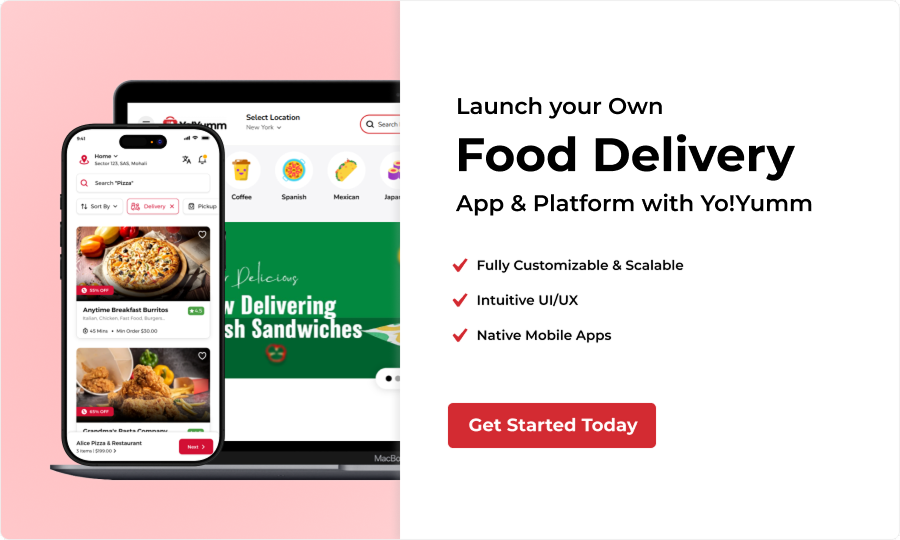
For entrepreneurs looking to launch without developing every marketplace component from scratch, Yo!Yumm is a ready-made food delivery solution worth considering. It provides a pre-built foundation for launching a branded food delivery marketplace, allowing businesses to focus on configuration, customization, integrations, and market launch.
This approach can be particularly useful for entrepreneurs who want to validate their food delivery concept, enter the market faster, or start with an MVP before investing in deeper custom development.
Launch Your Food Delivery Marketplace Leveraging Yo!Yumm
Conclusion
Choosing between custom development and a readymade solution for building a food delivery app depends on what you want to achieve with your food delivery marketplace.
A custom food delivery app provides greater flexibility, customization, control, and long-term development possibilities. It can be a strong option for businesses that want to create a differentiated platform with unique features and workflows.
A readymade food delivery solution, on the other hand, can help businesses launch faster with pre-built functionality and lower initial development effort. It can be particularly useful for startups, businesses testing a new market, and companies looking to launch an MVP.
The best approach is not necessarily the one with the lowest initial cost or fastest development time. Instead, consider your business model, target audience, required features, budget, launch timeline, scalability requirements, customization needs, and long-term growth strategy. By evaluating these factors carefully, you can choose a food delivery app development approach that supports your current business goals while giving you room to grow.
FAQs
Is custom food delivery app development better than a readymade solution?
Neither option is universally better. Custom development is generally a better fit for businesses that need unique features, specialized workflows, and extensive control. A readymade solution, on the other hand, can be suitable for businesses prioritizing faster launch and pre-built functionality.
How long does it take to build a custom food delivery app?
The timeline to build a custom food delivery app varies depending on various factors. The number of applications, features, integrations, UI/UX complexity, testing requirements, and overall project scope. A platform with multiple stakeholder applications and extensive customization will generally require more time to build and deploy.
How quickly can a readymade food delivery solution be launched?
A readymade solution can generally be deployed faster because its core functionality is already available. However, the final timeline depends on configuration, branding, customization, integrations, testing, and deployment requirements.
Which is more scalable: custom development or a readymade solution?
Both approaches can support growth, but differ in the level of control available. Custom development generally provides greater flexibility over future scalability and architecture. With a readymade food delivery solution, scalability depends on the platform’s architecture, infrastructure, provider capabilities, and available upgrade options.
Can I customize a readymade food delivery solution?
Yes, depending on the platform and provider. Available customization may include branding, selected features, workflows, integrations, and other components. Before choosing a solution, confirm which areas can be modified and which are restricted by the platform’s architecture.
What features should a food delivery marketplace have?
Features of a food delivery marketplace typically include:
- A customer app
- Restaurant dashboard
- Delivery partner app
- Admin panel
- Restaurant discovery
- Menu management
- Ordering
- Payments
- Delivery tracking
- Order management
- Commissions
- Reporting
Should a startup choose custom development or a readymade food delivery solution?
For a startup focused on quickly testing an idea or launching an MVP, a readymade solution can provide a practical starting point. Custom development may make more sense when a startup has unique requirements, sufficient resources, and a long-term strategy for building a differentiated technology platform.
Find the Right Approach for Building Your Food Delivery App
Get In Touch